

Categories
Change Password!
Reset Password!



This study sought to explore the effectiveness of locally administered oxymetazoline, tranexamic acid, and an epinephrine–lidocaine combination in managing acute epistaxis, as well as to compare their benefits in attaining bleeding control.
Oxymetazoline shows significantly greater hemostasis success than tranexamic acid and epinephrine-lidocaine in acute epistaxis management.
This study sought to explore the effectiveness of locally administered oxymetazoline, tranexamic acid, and an epinephrine–lidocaine combination in managing acute epistaxis, as well as to compare their benefits in attaining bleeding control.
In this prospective, observational cohort study, the initial management involved applying direct pressure to the nasal alae for 15 minutes. Patients with ongoing bleeding then received one of the three topical agents, selected based on the treating physician’s clinical judgment. Hemostasis was investigated at 5-minute intervals.
Overall, 378 adult patients with non-traumatic epistaxis were enrolled. Notably, 5 patients were excluded for leaving the emergency department prior to completing treatment, leaving 373 for analysis. Hemostasis was attained with pressure therapy alone in 89 patients (23.8%). Of the remaining 284 patients, bleeding control was attained in a higher no. of patients in the oxymetazoline group when compared to tranexamic acid and epinephrine–lidocaine (Table 1).
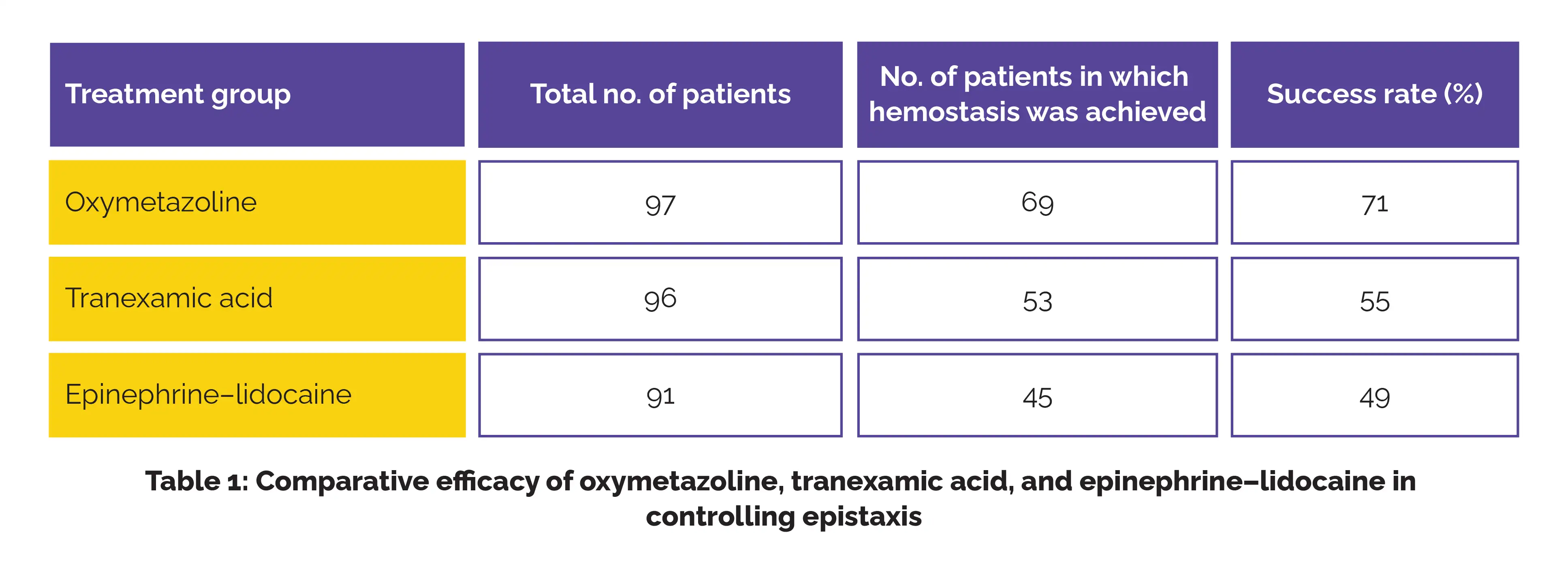
Statistical analysis revealed vital differences in hemostatic success between the treatment groups, with oxymetazoline illustrating the highest efficacy (p = 0.007).
Oxymetazoline outperformed tranexamic acid and epinephrine–lidocaine in rapidly attaining hemostasis and lowering recurrence rates in epistaxis. Its rapid onset, easy availability, and broad accessibility make it a practical choice for emergency care.
American Journal of Emergency Medicine
Comparison of the efficacy of oxymetazoline, tranexamic acid, and epinephrine-lidocaine combination in the treatment of epistaxis
Tuna Celik et al.















Comments (0)