EN | UA
EN | UA

Help Support

Back

Lobeglitazone combination therapy improves glycemic control in type 2 diabetes

Type 2 diabetes Type 2 diabetes

Type 2 diabetes (T2D), a chronic condition caused by insulin resistance and β-cell dysfunction, leads to high blood sugar, which is often considered difficult to control with lifestyle changes and oral medications.

See All

Key take away

Lobeglitazone added to metformin and sitagliptin provides a powerful triple therapy that lowers HbA1c by 1%, improves insulin sensitivity, and enhances lipid profiles, offering a safe and effective option for patients with uncontrolled blood sugar.

Background

Type 2 diabetes (T2D), a chronic condition caused by insulin resistance and β-cell dysfunction, leads to high blood sugar, which is often considered difficult to control with lifestyle changes and oral medications. Early and effective combination therapy is fundamental for preventing complications and boosting treatment outcomes. Metformin continues to be the standard first-line therapy for T2D because of its proven effectiveness and affordability.

Sitagliptin, the earliest dipeptidyl peptidase-4 (DPP-4) inhibitor, has the strongest supporting evidence within its drug class. Compared to Western populations, Asians typically exhibit greater insulin secretion defects owing to reduced beta-cell mass and function, which makes them more responsive to DPP-4 inhibitors. For this reason, metformin combined with a DPP-4 inhibitor is the most common strategy in Korean patients. However, as dual therapy often has limited durability and diabetes tends to progress over time, the use of triple oral therapy is becoming increasingly common.

Thiazolidinediones (TZDs) improve insulin sensitivity, but older drugs in this class have safety concerns. Lobeglitazone, a new TZD, shows stronger effects and better safety in preclinical and clinical studies. It helps improve insulin secretion, reduces cellular stress, and exhibits anti-inflammatory properties, all of which contribute to protecting β-cell function and enhancing blood sugar control. Early clinical trials suggest lobeglitazone is safe, with fewer serious side effects compared to other TZDs.

Because of these benefits, lobeglitazone could be a useful third drug added to metformin and sitagliptin, especially in Asian patients who often include older and non-obese individuals. While SGLT-2 inhibitors are preferred for triple therapy in some guidelines, TZDs like lobeglitazone may offer a good alternative. However, there is limited research on adding a TZD to dual therapy with metformin and DPP-4 inhibitors.

Objective

This randomized, placebo-controlled, phase III clinical trial evaluated the efficiency and safety of lobeglitazone as an add-on therapy to metformin and sitagliptin in Korean patients with T2D who had inadequate glycemic control with dual oral therapy.

Method

This 52-week trial was conducted across 19 clinical sites in the Republic of Korea between April 2018 and December 2021 in accordance with the Declaration of Helsinki, Good Clinical Practice (GCP) guidelines, and the International Conference on Harmonisation (ICH) standards.

Inclusion criteria

Participants were included if they:

  • Were aged 19 to 80 years
  • Had a confirmed diagnosis of T2D
  • Had been on stable doses of metformin (≥1000 mg/day) and sitagliptin (100 mg/day) for at least 10 weeks prior to screening
  • Had glycated hemoglobin (HbA1c) levels between 7.0% and 10.0% at both screening and the end of a 2-week run-in period
  • Had a body mass index (BMI) of 21–40 kg/m²
  • Had a fasting C-peptide level ≥1.0 ng/mL

Exclusion criteria

  • Diagnosis of type 1 diabetes or secondary forms of diabetes
  • History of cardiovascular events (e.g., myocardial infarction, stroke, unstable angina, or heart failure class III/IV) within the past 6 months
  • History of malignancy within the last 5 years
  • Use of insulin, systemic corticosteroids, or other prohibited medications during the study period
  • Any condition that, in the opinion of investigators, could interfere with study participation or interpretation of results

Data extraction

  • Data were collected prospectively during three phases:
    (a) A 2-week run-in period to standardize treatment.
    (b) A 24-week double-blind treatment phase where patients were randomized (1:1) to receive either lobeglitazone 0.5 mg or placebo, while continuing their metformin (1000 mg/day) and sitagliptin (100 mg/day).
    (c) A 28-week open-label extension during which all participants received lobeglitazone.
  • Data was collected on efficacy parameters, adverse events, laboratory tests, and treatment adherence. All data was centrally processed and validated.

Study outcomes

(a) Primary endpoint

  • Alteration in HbA1c from baseline at 24 weeks.

(b) Secondary endpoints

  • HbA1c alterations at 52 weeks.
  • Alteration in quantitative insulin-sensitivity check index (QUICKI), fasting plasma glucose (FPG), homeostatic model assessment for insulin resistance (HOMA-IR), and HOMA for β-cell function (HOMA-β) at 24 and 52 weeks.
  • Lipid profile changes: High-density lipoprotein cholesterol (HDL-C), low-density lipoprotein cholesterol (LDL-C), triglycerides, small dense LDL-C, free fatty acids, and total cholesterol.
  • Proportion of people achieving HbA1c <6.5% and <7% at 24 and 52 weeks.

(c) Safety outcomes

  • Incidence of adverse events, abnormal laboratory findings, and alterations in vital parameters.

Data and statistical analysis

  • Sample size calculation was based on detecting a clinically meaningful HbA1c difference of −0.44% between groups. The calculation assumed a standard deviation of 0.94, provided 90% power at a two-sided significance level of 5%, and accounted for 15% dropout.
  • Effectiveness analyses were carried out on the modified full analysis set (mFAS). Supplementary analyses used the modified per-protocol set. Utilizing the last observation carried forward method, the missing data in mFAS were handled. Safety analyses were executed on all people who received at least 1 dose of the study drug (Safety Set).
  • Primary and secondary outcomes were examined using analysis of covariance (ANCOVA), tailoring for baseline HbA1c and its stratification (<8.5% or ≥8.5%). Proportional outcomes were assessed via Fisher’s exact test or Pearson’s chi-square. A p-value <0.05 was deemed statistically significant.

Result

Key findings

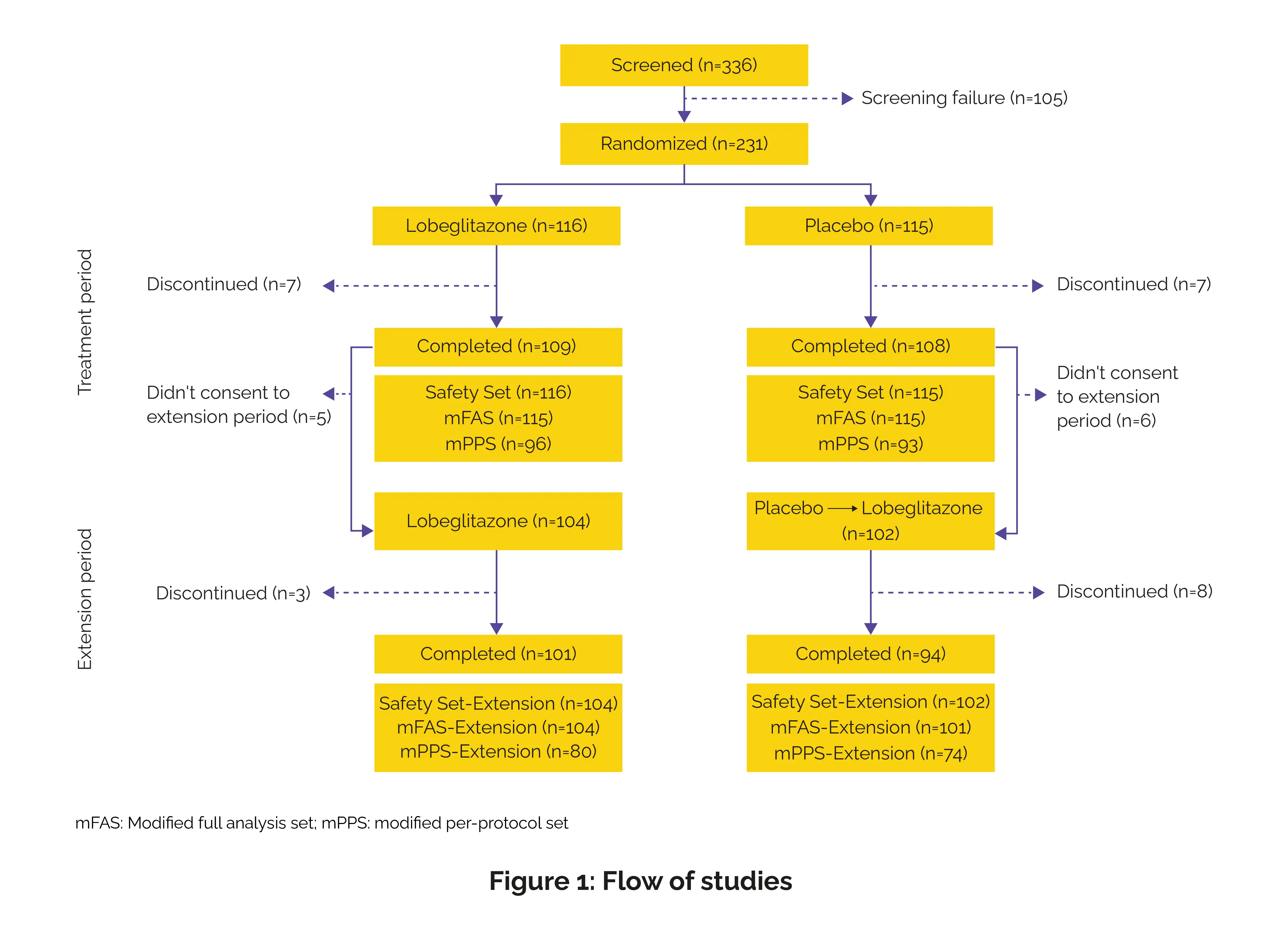
  • Of 336 subjects screened, 231 were randomized to get either placebo (115 patients) or lobeglitazone 0.5 mg (116 patients). Overall, 217 subjects completed the treatment period, and 195 subjects continued through and completed the extension period.
  • The mean age of the enrolled subjects was 58.65 ± 10.17 years, mean BMI was 25.45 ± 2.75 kg/m², mean duration of T2D was 10.97 ± 7.37 years, and the mean baseline HbA1c was 7.84% ± 0.65%.
  • Most demographic characteristics were similar between the groups at baseline, although prominent differences were noted in body weight, FPG, and BMI.
  • At week 24, lobeglitazone use resulted in a substantially greater decrease in HbA1c than placebo (−1.00% ± 0.09% vs. 0.02% ± 0.09%), with a between-group adjusted mean difference of −1.03% (p < 0.0001), indicating robust glycemic control.
  • HbA1c reductions with lobeglitazone were maintained through 52 weeks, including patients switching from placebo. At week 24, a higher percentage of volunteers in the lobeglitazone group achieved target HbA1c levels as opposed to placebo:
    (a) HbA1c <6.5%: 27.14% vs. 0.87%
    (b) HbA1c <7.0%: 53.04% vs. 13.04%
  • FPG levels were markedly reduced in the lobeglitazone arm (the difference in the adjusted mean change vs. placebo was -30.60 mg/dL).
  • Insulin sensitivity and β-cell function showed significant improvement with lobeglitazone, reflected by HOMA-IR (decreased insulin resistance), HOMA-β (enhanced β-cell function), and QUICKI (improved insulin sensitivity).
  • Lipid metabolism was positively influenced, with improvements in key lipid parameters observed following lobeglitazone use.
  • The overall rate of adverse events was 27.6% in the lobeglitazone arm and 30.4% in the placebo arm, with no pivotal difference. Serious adverse events and drug-related reactions were similar between the groups.
  • From week 24 to week 52, adverse event rates remained comparable (22.1% vs. 19.6%). In most cases, adverse events were mild or moderate. No severe cases were documented.
  • Oedema, a known side effect of TZDs, occurred in 3.5% of lobeglitazone patients; all cases were mild with the exception of one moderate eyelid swelling.
  • Patients on lobeglitazone gained weight (1.69 kg) and BMI (0.62 kg/m2), while the placebo group lost a small amount of weight and BMI; these differences were significant.
  • Systolic blood pressure did not change, and diastolic blood pressure showed a small statistical change but was not clinically meaningful. No patients experienced fractures, heart failure, or liver enzyme elevations.
  • Overall, lobeglitazone was well-tolerated, with only mild, expected side effects.

Discussion

This study highlights lobeglitazone’s strong efficacy as an add-on therapy, achieving a remarkable 1% reduction in HbA1c at 24 weeks, which exceeds typical reductions seen with other triple therapy combinations. The glycemic benefits persisted through 52 weeks, alongside notable improvements in insulin resistance and β-cell function, even in patients with long-standing diabetes inadequately controlled on metformin and DPP-4 inhibitors.

The sustained reduction highlights the glucose-lowering potency of lobeglitazone and reinforces the durability of TZD therapy that has been demonstrated in previous studies, including real-world data showing efficiency for up to 42 months in over 2,000 patients. Lobeglitazone demonstrated a favorable safety profile, with only mild oedema and manageable weight gain observed.

Additionally, it positively influenced lipid metabolism by reducing small dense LDL-C and free fatty acids while increasing HDL-C, suggesting potential cardiovascular benefits. While results are promising, longer-term studies are warranted to confirm sustained effectiveness and safety. Overall, lobeglitazone appears to be a valuable addition to triple therapy regimens, offering enhanced glycemic control and metabolic improvements that may contribute to better long-term outcomes in T2D management.

Limitations

  • The 12-month study period may be insufficient to examine long-term efficacy and safety.
  • No direct comparison with other triple therapy regimens was performed.
  • Results may not generalize to individuals with higher baseline HbA1c or diverse populations.

Clinical take-away

Lobeglitazone added to metformin and sitagliptin combination therapy showed consistent glycemic efficacy, enhanced insulin dynamics, and favorably modified lipid parameters, presenting a well-tolerated and effective option for patients with inadequately controlled T2D.

Source:

Diabetes, Obesity and Metabolism

Article:

Efficacy and safety of lobeglitazone added to metformin and sitagliptin combination therapy in patients with type 2 diabetes: A 52-week, multicentre, randomized, placebo-controlled, phase III clinical trial

Authors:

Eun-Gyoung Hong et al.

Comments (0)

You want to delete this comment? Please mention comment Invalid Text Content Text Content cannot me more than 1000 Something Went Wrong Cancel Confirm Confirm Delete Hide Replies View Replies View Replies en ru
Try: